The Simplifier Method®
Understand. Simplify. Act. Impact.
Complexity can make people hesitate.
When there’s too much information, too many choices or too many competing priorities, it becomes difficult to know what matters and what to do next.
The Simplifier Method® is a practical framework for moving from complexity to clarity—and from clarity to meaningful action.
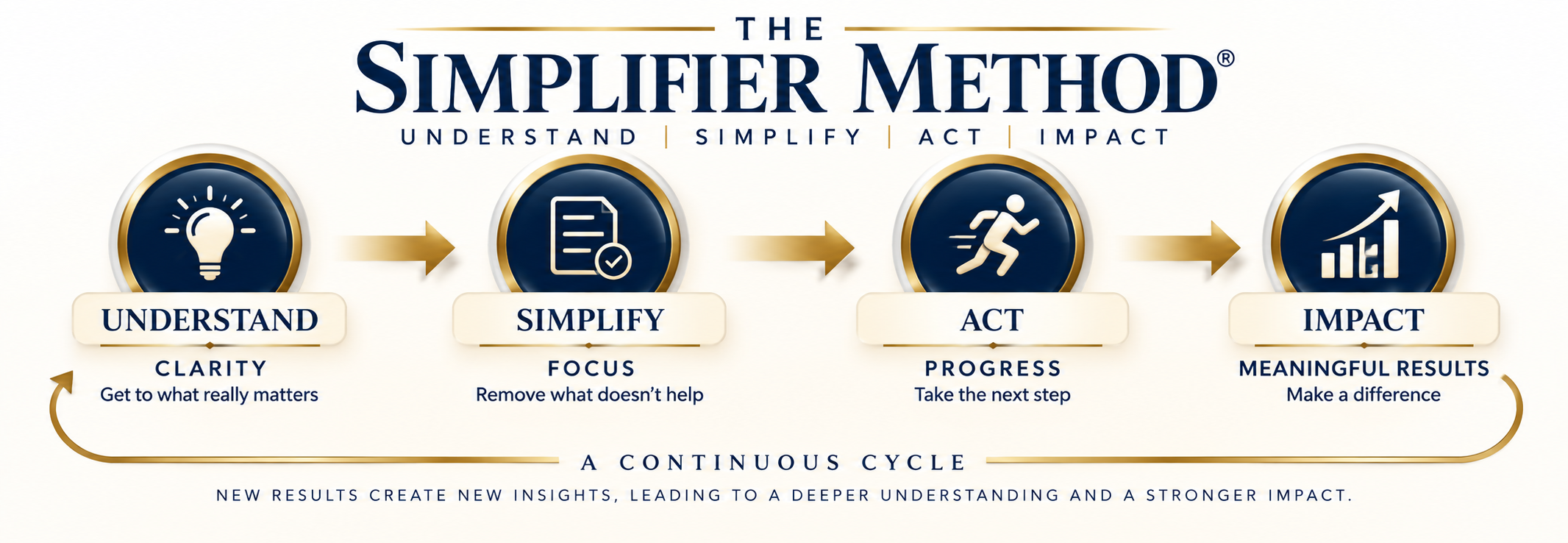
It is built around four simple steps:
UNDERSTAND → SIMPLIFY → ACT → IMPACT
The goal isn’t to know everything.
The goal is to understand what matters, simplify what feels complicated, take the right next action and create an impact that moves something—or someone—forward.
1. UNDERSTAND
Before you simplify something, you have to understand it.
We often rush toward solutions before we fully understand the problem.
The first step of The Simplifier Method® is to slow down long enough to ask better questions.
What is really happening?
What matters most?
What information do I actually need?
What am I assuming?
Who needs to be heard?
Understanding requires curiosity.
It requires listening.
And sometimes it requires admitting that we don’t know enough yet.
You can’t simplify what you haven’t taken the time to understand. – OE
The goal: CLARITY
2. SIMPLIFY
Remove what doesn’t help you move forward.
Once you understand the situation, the next step is to separate what matters from everything that doesn’t.
Simplifying doesn’t mean making something less important.
It means making the important things easier to see.
Ask:
What can be removed?
What is creating unnecessary confusion?
What are the priorities?
Can this be explained more clearly?
What’s the simplest way to move forward without losing what matters?
The best solution isn’t always the most complicated one.
Sometimes clarity comes from removing something rather than adding something.
Simplicity isn’t about knowing less. It’s about understanding what matters. – OE
The goal: FOCUS
3. ACT
Clarity has little value if we never do anything with it.
Understanding gives us clarity.
Simplifying gives us focus.
But eventually, we have to move.
The third step is about turning understanding into action.
Ask:
What’s the next step?
Not the next ten steps.
Not everything that could possibly happen.
Just:
What can I do next?
Action doesn’t always require a perfect plan.
Sometimes it requires enough clarity to take one meaningful step and learn from what happens next.
You don’t need to see the entire path to take the next step. – OE
The goal: PROGRESS
4. IMPACT
Action should lead somewhere.
The final step is to look beyond activity and ask whether what we’re doing is actually making a difference.
Impact isn’t always measured by size.
Sometimes impact is helping one person understand.
Sometimes it’s improving one process.
Sometimes it’s making a better decision.
Sometimes it’s opening a door for someone else.
And sometimes it’s simply leaving something better than you found it.
Ask:
What changed?
Who benefited?
What did we learn?
What should we continue?
What should we simplify again?
Because impact also creates new information—and that brings us back to understanding.
The goal: MEANINGFUL RESULTS
The Method Is a Cycle
This is something I particularly want on the page because it makes your framework stronger.
The Simplifier Method® isn’t simply four boxes in a straight line.
It’s a continuous cycle:
UNDERSTAND → SIMPLIFY → ACT → IMPACT
and then:
IMPACT → LEARN → UNDERSTAND AGAIN
Every action teaches us something.
Every result gives us new information.
And every new understanding gives us another opportunity to simplify.
That’s how growth happens.
Where Can You Use The Simplifier Method®?
Almost anywhere complexity gets in the way of clarity.
Business
Understand the real challenge. Simplify the choices. Act on the priority. Measure the impact.
Leadership
Understand your people. Simplify the message. Act with intention. Create meaningful impact.
Communication
Understand before responding. Simplify what you’re trying to say. Communicate clearly. Pay attention to what happens next.
Decision-Making
Understand the decision. Remove unnecessary noise. Choose the next action. Learn from the result.
Personal Growth
Understand where you are. Simplify what needs your attention. Take one meaningful step. Recognize your progress.
Relationships
Understand the other person. Remove assumptions. Communicate clearly. Strengthen the relationship.
The Simplifier Question
I want to introduce something memorable here that can eventually become part of your workshops and speaking:
Whenever you’re facing complexity, ask yourself:
What needs to become clearer before I can move forward?
That question forces you to stop adding more information and start looking for understanding.
Then apply the Method:
UNDERSTAND
What do I need to understand?
SIMPLIFY
What actually matters?
ACT
What can I do next?
IMPACT
What difference should that action make?
Becoming a Simplifier
The Simplifier Method® isn’t only a framework for solving problems.
It’s a way of thinking.
A simplifier doesn’t add complexity to demonstrate expertise.
A simplifier creates clarity so other people can move forward.
That’s why the Method ultimately isn’t about information.
It’s about people.
Understand more.
Simplify more.
Act with intention.
Create greater impact.
– Orlando Espinosa
The Simplifier of Information™
Discover the philosophy behind the Method → The Simplifier of Information™
Discover the book → The Simplifier of Information: Turning Complexity Into Clarity and Action